Free preview. Try it now — a free account opens the rest.Sign up free
Loading
About this study app
PHAR4009 Pharmacology Honours · University of the Witwatersrand · Winter 2026
PHAR4009 Pharmacology Honours (Wits) toxicology practice quiz covers heavy metals, solvents, alcohols, radiation, venomous bites and stings, and plants and mushrooms through two sets of 50 multiple-choice questions with five options each and an answer memo.
Built from prompt
Create multiple choice practice questions on these notes in the files titled "tox5 - heavy metals", "tox 6", "tox 7 - venomous bites and stings", and "tox 8 - plants and mushroons". The format must be as follows: 2 sets of questions, with 50 questions each, with all sections mixed together in the questions. There must be 5 options per question. 3 options can be correct with the remaining 2 incorrect, or 3 options can be incorrect with the remaining 2 correct. The sequence of options in each question must be in a random order. Include a memo. The file titled "tut.pdf" is an example of the style and level of questions that need to be asked. The file titled "tox tut memo with reasons" contains questions I selected from a previous prompt I entered. Do not just copy these questions, they are meant to guide you in making new questions.
Adverse Drug Reactions and Pharmacokinetic Interactions: Part 1by Jonathan BekkerPHAR4009 Pharmacology Honours at Wits covers adverse drug reactions and pharmacokinetic interactions through a comprehensive quiz examining drug-induced skin reactions, organ toxicities, protein binding competition, enzyme interactions, and clinical case scenarios. This study tool tests understanding of ADR classificatWinter 2026
Distinguish between Type A (augmented) and Type B (bizarre) adverse drug reactions by detailing the predictability, dose dependence, and underlying mechanism or resolution of each type as outlined in the course material.
6 marks
Compare phototoxic drug reactions with photoallergic drug reactions by outlining the immunological basis, dose relationship, exposure timing, and cross-sensitivity of each reaction based on the provided material.
18 questions · 104 marks
Practice Q&A
Adverse Drug Reactions: Classification and Cutaneous Mechanismsby Jonathan BekkerPHAR4009 Pharmacology Honours at Wits features a Q&A study tool covering adverse drug reactions, including classification systems, cutaneous mechanisms, hypersensitivity types, and organ-specific toxicities. The tool contains 18 practice questions ranging from 5-7 marks addressing clinical presentations, pathological dWinter 2026
Adverse Drug Reactions and Immunopathological Mechanismsby Jonathan BekkerPHAR4009 Pharmacology Honours (Wits) quiz covering adverse drug reactions and immunopathological mechanisms, including Type A through D classifications, hypersensitivity reactions, drug-induced conditions like Stevens-Johnson syndrome and warfarin-induced skin necrosis, and clinical management of adverse responses.Winter 2026
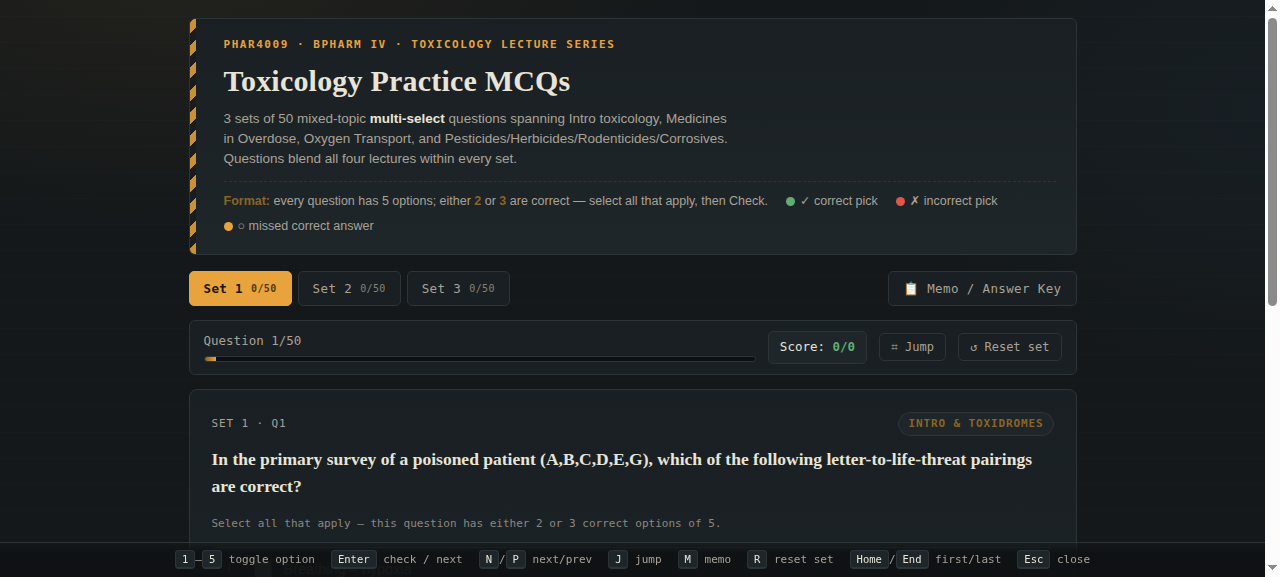
Toxicology Practice MCQs — 3 Sets × 50 (Multi-Select)by Jonathan BekkerPHAR4009 Pharmacology Honours at Wits features three sets of 50 multi-select practice questions covering toxicology topics including introduction to toxicology, medicines, oxygen transport, and herbicides, pesticides, and corrosives. Each question offers five options with varying correct-answer combinations to prepare Winter 2026