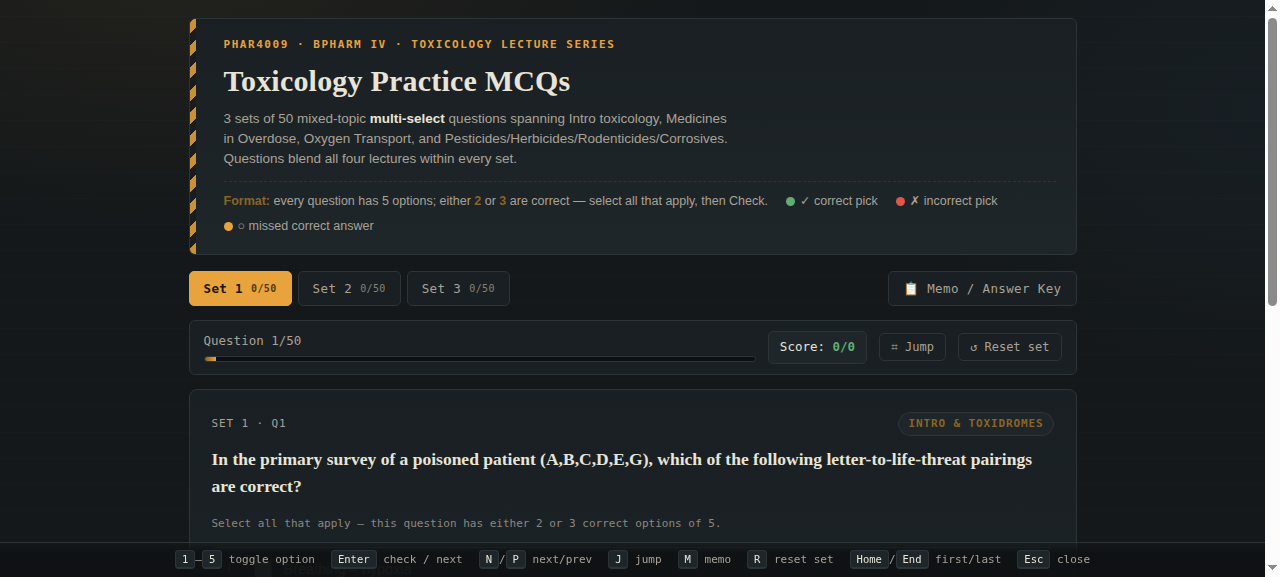
Taking PHAR4009 Pharmacology Honours at University of the Witwatersrand?
Wits · PHAR4009
Adverse Drug Reactions: Classification and Cutaneous Mechanisms — PHAR4009
PHAR4009 Pharmacology Honours · University of the Witwatersrand · Winter 2026
PHAR4009 Pharmacology Honours at Wits features a Q&A study tool covering adverse drug reactions, including classification systems, cutaneous mechanisms, hypersensitivity types, and organ-specific toxicities. The tool contains 18 practice questions ranging from 5-7 marks addressing clinical presentations, pathological d
Built from prompt
create it as a question set then
2 of 18 questions · 104 marks
- Characteristics of Type A and Type B Adverse Drug Reactions6 marks
Distinguish between Type A (augmented) and Type B (bizarre) adverse drug reactions by detailing the predictability, dose dependence, and underlying mechanism or resolution of each type as outlined in the course material.
- Distinguishing Phototoxicity from Photoallergy6 marks
Compare phototoxic drug reactions with photoallergic drug reactions by outlining the immunological basis, dose relationship, exposure timing, and cross-sensitivity of each reaction based on the provided material.
Open all 18 questions free
A free account opens this one and one more on us. No card needed.
Already have an account? Log in
Want unlimited access? Standard · $24.99/4 months
More from PHAR4009 Pharmacology Honours
- Open Adverse Drug Reactions and Pharmacokinetic Interactions: Part 11 of 50Quiz
Which of the following statements correctly distinguish pharmacological concepts according to the accepted definitions of adverse drug reactions?
- An adverse reaction is formally defined as an unintended beneficial response that…
- Mutagenicity, carcinogenicity, and teratogenicity are classified as non-toxic…
- Idiosyncrasy denotes an inherent qualitative abnormal reaction to a drug, typically…
- Intolerance refers to an abnormally low threshold to the normal pharmacological action of…
- Toxicity always implies an absolute massive overdose and cannot occur at standard…
50 questionsTry this quizQuizAdverse Drug Reactions and Pharmacokinetic Interactions: Part 1by Jonathan BekkerPHAR4009 Pharmacology Honours at Wits covers adverse drug reactions and pharmacokinetic interactions through a comprehensive quiz examining drug-induced skin reactions, organ toxicities, protein binding competition, enzyme interactions, and clinical case scenarios. This study tool tests understanding of ADR classificatWinter 2026 - Open Adverse Drug Reactions and Immunopathological Mechanisms1 of 50Quiz
Which of the following characteristics correctly defines a Type A (augmented) adverse drug reaction?
- It typically emerges years after completion of therapy due to irreversible accumulation.
- It is predictable, dose-related, and can be alleviated by reducing the dosage.
- It is an immunologically mediated hypersensitivity reaction seen only in atopic patients.
- It is an unpredictable, bizarre effect that occurs independently of the administered dose.
50 questionsTry this quizQuizAdverse Drug Reactions and Immunopathological Mechanismsby Jonathan BekkerPHAR4009 Pharmacology Honours (Wits) quiz covering adverse drug reactions and immunopathological mechanisms, including Type A through D classifications, hypersensitivity reactions, drug-induced conditions like Stevens-Johnson syndrome and warfarin-induced skin necrosis, and clinical management of adverse responses.Winter 2026 - Open Toxicology Practice Quiz: Heavy Metals, Solvents/Alcohols/Radiation, Venomous Bites & Stings, Plants & Mushrooms (2 × 50 Q)
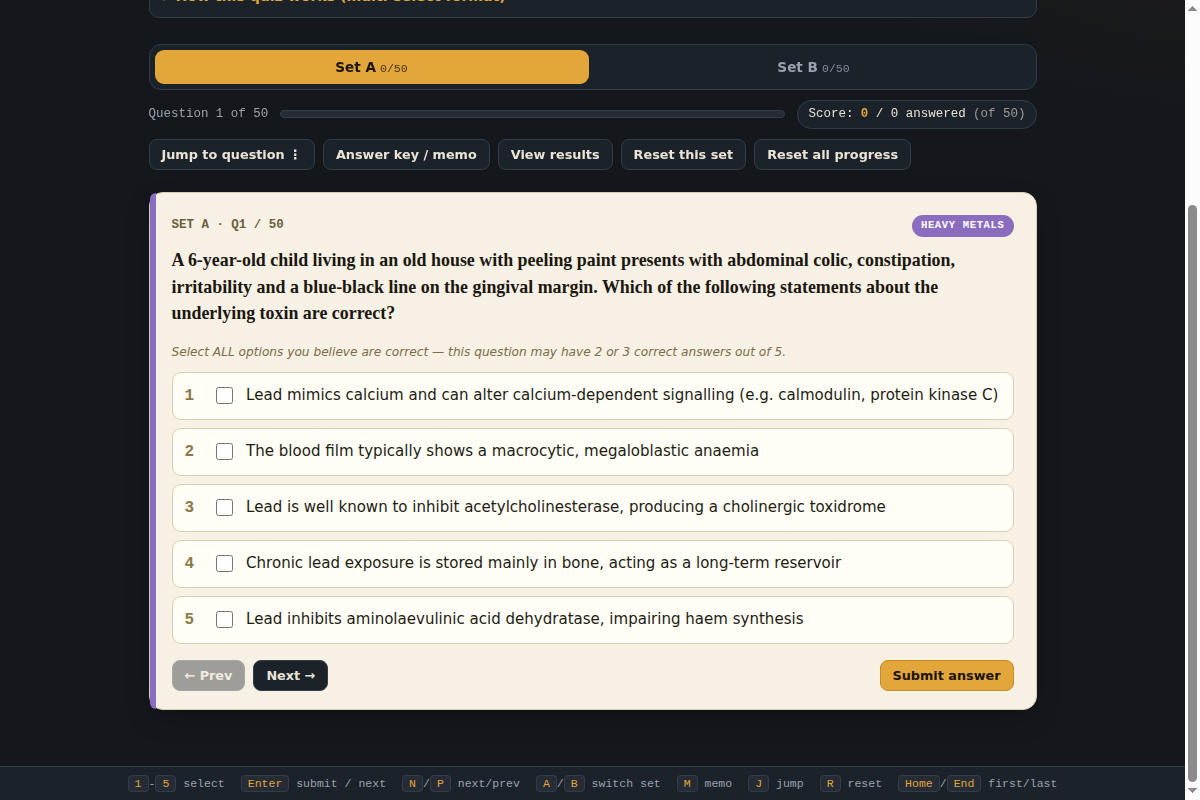 Practice Q&AToxicology Practice Quiz: Heavy Metals, Solvents/Alcohols/Radiation, Venomous Bites & Stings, Plants & Mushrooms (2 × 50 Q)by Jonathan BekkerPHAR4009 Pharmacology Honours (Wits) toxicology practice quiz covers heavy metals, solvents, alcohols, radiation, venomous bites and stings, and plants and mushrooms through two sets of 50 multiple-choice questions with five options each and an answer memo.Winter 2026