• agofactAgoFact
  • Discover
  • Build your own
  • Sign in
  • Get started free
agofactAgoFact
  1. Discover/
  2. UCLA/
  3. MSE104 Material Science 104

UCLA

MSE104 Material Science 104

48 study tools for MSE104 Material Science 104 at University of California, Los Angeles.

Winter 2022
  • Open Materials Science: Mechanical Properties, Phase Equilibria, and Transport
    Quiz
    1 of 50

    In a standard Charpy impact test, how is the impact energy absorbed by a fractured specimen calculated?

    • AFrom the integration of the area beneath the engineering stress versus engineering strain…
    • BFrom the depth and diameter of the plastic indentation produced on the specimen surface…
    • CFrom the instantaneous angular velocity of the swinging hammer at the moment of initial…
    • DFrom the difference between the initial pendulum release height h and the final rebound…
    50 questions
    Try this quiz
    Quiz
    Materials Science: Mechanical Properties, Phase Equilibria, and Transportby Keroshan PillayMSE104 Materials Science 104 at UCLA covers mechanical properties, phase equilibria, and transport phenomena through a comprehensive quiz featuring questions on impact testing, hardness-strength relationships, binary alloy microstructures, carbon steel phase transformations, creep, fatigue, and thermal radiation analysDr. Amartya Banerjee · Winter 2022Made about 2 months ago
Build Now
  • Open Materials Science and Thermal Physics Assessment
    Quiz
    1 of 15

    In standard binary phase diagram representations used in materials science, which two independent state variables are plotted under typical atmospheric pressure conditions?

    • ADensity and chemical concentration
    • BTemperature and alloy composition
    • CPressure and chemical concentration
    • DVolume and absolute temperature
    15 questions
    Try this quiz
    Quiz
    Materials Science and Thermal Physics Assessmentby Keroshan PillayMSE104 Materials Science 104 at UCLA covers thermal physics and materials behavior through a quiz assessing phase diagrams, creep mechanisms, fracture toughness, phase transformations, diffusion, radiation heat transfer, and crystal defects.Dr. Amartya Banerjee · Winter 2022Made about 2 months ago
  • Open Materials Science: Mechanical Behavior and Phase Diagrams
    Flashcards1 of 24 cards
    1. 02At what stress level relative to yield strength can fatigue failure occur?
    2. 03How does reducing the magnitude of mean stress affect fatigue life?
    3. +21 more in the deck
    Flashcards
    Materials Science: Mechanical Behavior and Phase Diagramsby Keroshan PillayMSE104 Materials Science 104 at UCLA covers mechanical behavior and phase diagrams through flashcards addressing impact testing, fatigue, creep, phase diagrams including the iron-carbon system, and elasticity theory. Topics include the Charpy test, stress-strain relationships, auxetic materials, fracture mechanics, andDr. Amartya Banerjee · Winter 2022Made about 2 months ago
  • Open MSE 104 Tutorial: Creep Kinetics and Invariant Phase Reactions
    Practice Q&A

    Explain the key characteristics of steady-state creep deformation in metals at elevated temperatures. Specifically, clarify why the strain rate remains constant during this stage, state the functional dependence of the…

    6 marks
    In binary phase diagrams, invariant reactions occur at specific equilibrium temperatures and compositions. Define and distinguish the eutectic, eutectoid, and peritectic reactions by identifying the reactant and product…
    5 questions · 30 marks
    Practice Q&A
    MSE 104 Tutorial: Creep Kinetics and Invariant Phase Reactionsby Keroshan PillayMSE104 Material Science 104 Q&A tool from UCLA covering steady-state creep kinetics, invariant phase reactions, non-steady-state diffusion, elastic constants, and solidification microstructures with five practice question sets.Dr. Amartya Banerjee · Winter 2022Made about 2 months ago
  • Open MSE 104: Materials Science Review
    Flashcards1 of 25 cards
    1. 02What are the four Hume-Rothery rules for extensive substitutional solid solubility?
    2. 03How is the Burgers vector oriented relative to the dislocation line for edge versus screw dislocations?
    3. +22 more in the deck
    Flashcards
    MSE 104: Materials Science Reviewby Keroshan PillayMSE 104: Materials Science Review is a flashcard deck covering crystal defects, diffusion, mechanical properties, and failure mechanisms for UCLA's Material Science 104 course. The deck includes equilibrium vacancy concentration, Hume-Rothery rules, dislocation types, Fick's laws, stress-strain analysis, fracture criteDr. Amartya Banerjee · Winter 2022Made about 2 months ago
  • Open MSE 104 Tutorial Sheet: Solid Solutions, Diffusion, Fatigue, and Phase Equilibria
    Practice Q&A

    State the four Hume-Rothery rules that govern the formation of substitutional solid solutions when impurity atoms are added to a host metal, and explain the specific condition required by each rule.

    8 marks
    Define steady-state diffusion in solid materials, state the mathematical equation for Fick's first law while defining each variable, and explain how temperature influences the diffusion coefficient.
    4 questions · 40 marks
    Practice Q&A
    MSE 104 Tutorial Sheet: Solid Solutions, Diffusion, Fatigue, and Phase Equilibriaby Keroshan PillayMSE104 Material Science 104 Q&A study tool at UCLA covers solid solutions, diffusion, fatigue, and phase equilibria with practice questions on Hume-Rothery Rules, Fick's First Law, fatigue failure mechanisms, and phase calculations in hypoeutectoid steel.Dr. Amartya Banerjee · Winter 2022Made about 2 months ago
  • Open Materials Science and Physics Review: Part 1
    Quiz
    1 of 50

    Which fundamental condition dictates that crack growth will occur in a material according to fracture mechanics principles?

    • AK_Ic > Y * sigma_c * sqrt(pi * a)
    • Ba_c = pi * (K_Ic / (Y * sigma))^2
    • CK_Ic < Y * sigma_c * sqrt(pi * a)
    • Dsigma_c = (Y * sqrt(pi * a)) / K_Ic
    50 questions
    Try this quiz
    Quiz
    Materials Science and Physics Review: Part 1by Keroshan PillayMSE 104 Materials Science and Physics Review: Part 1 is a UCLA quiz covering fracture mechanics, phase diagrams, diffusion, dislocations, and mechanical properties of materials including Cu-Ni systems, creep behavior, and tensile testing. The tool contains 31 questions spanning equilibrium phase transformations, atomicDr. Amartya Banerjee · Winter 2022Made about 2 months ago
  • Open Materials Science Review Quiz: Part 1
    Quiz
    1 of 50

    Under Scenario 2 of design against fracture, where the fracture toughness K_Ic and operating tensile stress level sigma are fixed, how is the maximum allowable critical flaw size (a_c) calculated?

    • Aa_c = K_Ic / (Y * sqrt(pi * sigma))
    • Ba_c = (1 / pi) * (K_Ic / (Y * sigma))^2
    • Ca_c = (1 / sqrt(pi)) * (K_Ic / (Y * sigma))
    • Da_c = pi * ( (Y * sigma) / K_Ic )^2
    50 questions
    Try this quiz
    Quiz
    Materials Science Review Quiz: Part 1by Keroshan PillayMSE104 Materials Science 104 quiz at UCLA covers fracture mechanics, phase diagrams, material properties, and failure analysis through questions on flaw propagation, surface treatments, creep behavior, hardness testing, and stress-strain relationships.Dr. Amartya Banerjee · Winter 2022Made about 2 months ago
  • Open Materials Science and Engineering Comprehensive Review
    Quiz
    1 of 50

    Which of the following test conditions directly promotes brittle fracture during an impact test?

    • AHigh specimen ductility
    • BLow strain rate
    • CPresence of a notch
    • DElevated temperature
    50 questions
    Try this quiz
    Quiz
    Materials Science and Engineering Comprehensive Reviewby Keroshan PillayMSE104 Materials Science and Engineering at UCLA covers brittle fracture, fatigue life, phase diagrams, crystallography, mechanical properties, and thermal radiation through a comprehensive quiz format designed to test conceptual understanding across material behavior and engineering calculations.Dr. Amartya Banerjee · Winter 2022Made about 2 months ago
  • Open MSE 104: Mechanical Behavior, Diffusion, and Phase Equilibria
    Quiz
    1 of 10

    According to the Hume-Rothery rules, which condition favors extensive substitutional solid solubility between two metallic elements?

    • AThe two pure constituent metals must possess completely different crystal structures.
    • BThe difference in atomic radii between the two elements must exceed 15 percent.
    • CThe two participating elements must exhibit substantially different electronegativities.
    • DThe solvent metal has a greater tendency to dissolve a solute metal of higher valence.
    10 questions
    Try this quiz
    Quiz
    MSE 104: Mechanical Behavior, Diffusion, and Phase Equilibriaby Keroshan PillayMSE104: Mechanical Behavior, Diffusion, and Phase Equilibria is a UCLA quiz covering key concepts in material science including solid solubility, diffusion kinetics, elastic properties, phase diagrams, and fracture mechanics. This study tool tests understanding of Hume-Rothery rules, binary phase systems, mechanical teDr. Amartya Banerjee · Winter 2022Made about 2 months ago
  • Open MSE 104: Materials Science Core Concepts
    Flashcards1 of 10 cards
    1. 02How is the Burgers vector (b) oriented relative to the dislocation line for edge dislocations versus screw dislocations?
    2. 03State Fick's First Law for steady-state diffusion and define each variable.
    3. +7 more in the deck
    Flashcards
    MSE 104: Materials Science Core Conceptsby Keroshan PillayMSE 104: Materials Science Core Concepts at UCLA covers fundamental topics in materials science including crystal structures, diffusion, mechanical properties, and phase diagrams through an interactive flashcard deck. The deck contains 10 flashcards addressing Hume-Rothery rules, dislocations, diffusion, yield strengthDr. Amartya Banerjee · Winter 2022Made about 2 months ago
  • Open MSE 104: Mechanical Properties, Defects, Diffusion, and Phase Transformations
    Quiz
    1 of 15

    According to the Hume-Rothery rules, which of the following is an established condition for high solid solubility in substitutional solid solutions?

    • AThe solvent metal has a greater tendency to dissolve a metal of lower valence.
    • BThe atomic radius of solute and solvent must differ by less than 15%.
    • CThe solute and solvent should have substantially different electronegativities.
    • DThe two pure metals must possess completely different crystal structures.
    15 questions
    Try this quiz
    Quiz
    MSE 104: Mechanical Properties, Defects, Diffusion, and Phase Transformationsby Keroshan PillayMSE 104: Mechanical Properties, Defects, Diffusion, and Phase Transformations is a UCLA quiz covering mechanical properties, solid-state diffusion, phase diagrams, crack mechanics, and creep behavior in materials. This tool assesses understanding of Hume-Rothery rules, stress-strain analysis, fracture toughness, the irDr. Amartya Banerjee · Winter 2022Made about 2 months ago
  • Open MSE 104 Tutorial Sheet: Diffusion & Mechanical Properties of Metals
    Practice Q&A

    Explain the atomic mechanisms of vacancy diffusion and interstitial diffusion in crystalline solids, stating which mechanism occurs more rapidly and why. In addition, state the Arrhenius equation that describes the…

    7 marks
    Compare and contrast twin boundaries with ordinary grain boundaries in crystalline metals. In your response, specifically address: (1) the crystallographic orientation relationship across the boundary, (2) the boundary…
    4 questions · 26 marks
    Practice Q&A
    MSE 104 Tutorial Sheet: Diffusion & Mechanical Properties of Metalsby Keroshan PillayMSE104 Material Science 104 at UCLA features a Q&A tutorial covering diffusion mechanisms, grain boundaries, and mechanical properties of metals including tensile parameters and stress-strain relationships. Practice questions span diffusion and temperature dependence, twin versus ordinary grain boundaries, and plastic Dr. Amartya Banerjee · Winter 2022Made about 2 months ago
  • Open MSE 104 Vacancy Concentration Calculator
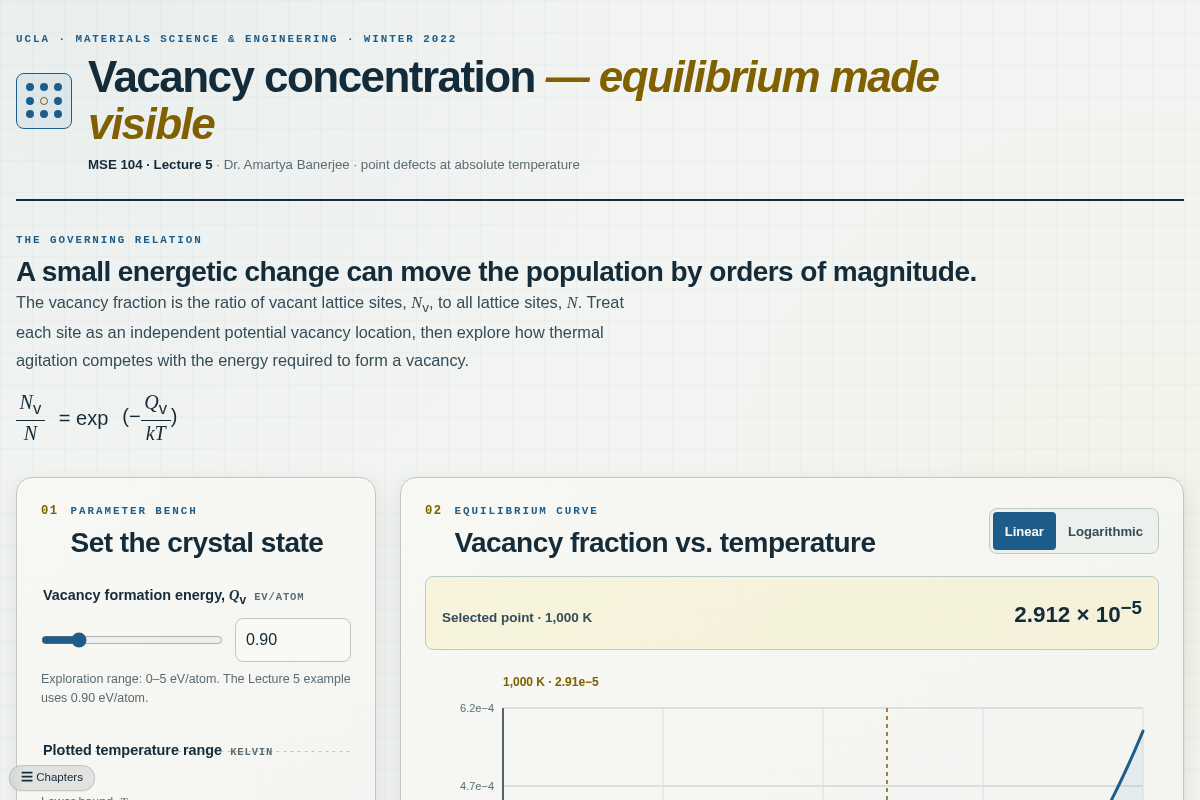
    Preview of MSE 104 Vacancy Concentration Calculator
    Simulator
    MSE 104 Vacancy Concentration Calculatorby Keroshan PillayThe MSE104 Vacancy Concentration Calculator is an interactive app for UCLA's Material Science 104 course that plots vacancy concentration (Nv/N) against temperature for user-selected activation energies, helping students visualize how defects respond to thermal conditions.Dr. Amartya Banerjee · Winter 2022Made about 2 months ago
  • Open MSE 104: Diffusion Mechanisms & Fundamentals
    Flashcards1 of 10 cards
    1. 02What is the distinction between self-diffusion and interdiffusion?
    2. 03How does the vacancy diffusion mechanism operate, and which atoms migrate this way?
    3. +7 more in the deck
    Flashcards
    MSE 104: Diffusion Mechanisms & Fundamentalsby Keroshan PillayMSE104 at UCLA covers diffusion mechanisms and fundamentals in materials science, including vacancy and interstitial diffusion, self-diffusion versus interdiffusion, and the temperature dependence of diffusion coefficients. This flashcard deck provides definitions, atomic mechanisms, key equations, and material exampleDr. Amartya Banerjee · Winter 2022Made about 2 months ago
  • Open MSE 104: Vacancies and Diffusion Mechanisms
    Quiz
    1 of 5

    According to the equilibrium vacancy concentration relationship Nv/N=exp⁡(−Qv/kT)N_v / N = \exp(-Q_v / kT)Nv​/N=exp(−Qv​/kT), how does the equilibrium concentration of vacancies change as temperature TTT increases?

    • AIt decreases linearly with increasing temperature.
    • BIt remains constant because the activation energy is fixed.
    • CIt decreases exponentially toward an asymptotic limit of zero.
    • DIt increases exponentially with increasing temperature.
    5 questions
    Try this quiz
    Quiz
    MSE 104: Vacancies and Diffusion Mechanismsby Keroshan PillayUCLA MSE 104 quiz on vacancies and diffusion mechanisms covers equilibrium vacancy concentration, interstitial versus vacancy diffusion, Fick's laws for steady and non-steady-state diffusion, and temperature-dependent diffusion coefficients through multiple-choice questions.Dr. Amartya Banerjee · Winter 2022Made about 2 months ago
  • Open MSE 104 - Lecture 5: Defects, Diffusion, and Mechanical Properties
    Flashcards1 of 15 cards
    1. 02What are the four Hume-Rothery rules governing extensive substitutional solid solubility?
    2. 03How is the Burgers vector (b) oriented relative to the dislocation line for edge versus screw dislocations?
    3. +12 more in the deck
    Flashcards
    MSE 104 - Lecture 5: Defects, Diffusion, and Mechanical Propertiesby Keroshan PillayUCLA MSE 104 flashcard deck covering Lecture 5 topics: crystal lattice defects, vacancy equilibrium, Hume-Rothery rules, edge and screw dislocations, Fick's diffusion laws, temperature effects on diffusion coefficient, and mechanical properties including stress-strain relationships, elastic moduli, yield and tensile stDr. Amartya Banerjee · Winter 2022Made about 2 months ago
  • Open MSE 104 Comprehensive Review: Defects, Diffusion, Mechanical Properties, Phase Diagrams, and Quantum Spin
    Quiz
    1 of 20

    According to the equilibrium vacancy concentration relationship, how does the equilibrium fraction of vacant lattice sites change as temperature increases?

    • AIt increases exponentially with absolute temperature.
    • BIt decreases logarithmically with absolute temperature.
    • CIt decreases linearly with absolute temperature.
    • DIt remains independent of temperature variations.
    20 questions
    Try this quiz
    Quiz
    MSE 104 Comprehensive Review: Defects, Diffusion, Mechanical Properties, Phase Diagrams, and Quantum Spinby Keroshan PillayMSE104 Material Science 104 quiz at UCLA covers defects, diffusion, mechanical properties, phase diagrams, and quantum spin through 20 comprehensive questions spanning crystal defects, stress-strain behavior, phase equilibria, and quantum mechanics fundamentals.Dr. Amartya Banerjee · Winter 2022Made about 2 months ago
  • Open Quantum Spin States and Operators
    Flashcards1 of 10 cards
    1. 02What 2x2 Pauli matrix represents the spin operator in the x-direction (σ^x\hat{\sigma}_xσ^x​)?
    2. 03What 2x2 Pauli matrix represents the spin operator in the y-direction (σ^y\hat{\sigma}_yσ^y​)?
    3. +7 more in the deck
    Flashcards
    Quantum Spin States and Operatorsby Keroshan PillayMSE104 Material Science 104 at UCLA covers quantum spin states and operators through flashcards examining Pauli matrices, eigenvalues, eigenvectors, and measurement probabilities in different spin directions. The deck includes applications of the Heisenberg Uncertainty Principle to spin measurements along orthogonal axDr. Amartya Banerjee · Winter 2022Made about 2 months ago
  • Open Quantum Spin States and Pauli Operators
    Flashcards1 of 15 cards
    1. 02What is the 2x2 matrix representation of the Pauli spin operator in the x-direction (σ^x\hat{\sigma}_xσ^x​)?
    2. 03What is the 2x2 matrix representation of the Pauli spin operator in the y-direction (σ^y\hat{\sigma}_yσ^y​)?
    3. +12 more in the deck
    Flashcards
    Quantum Spin States and Pauli Operatorsby Keroshan PillayMSE104 Material Science 104 at UCLA covers quantum spin states and Pauli operators through flashcards, helping students master matrix representations of spin operators, eigenvalues, eigenvectors, and measurement probabilities in quantum systems. The deck includes foundational concepts like operator equations, normalizaDr. Amartya Banerjee · Winter 2022Made about 2 months ago
  • Open MSE104 Tutorial Sheet: Mechanical Behavior, Fracture, and Failure Mechanisms
    Practice Q&A

    Using the principles of tensile deformation in metals, explain the atomic-level difference between elastic and plastic deformation. Describe how the yield strength is determined from an engineering stress-strain curve…

    8 marks
    Explain why the measured fracture strengths of real engineering materials are significantly lower than theoretical predictions. Detail the role of crack geometry in amplifying stress at crack tips, describe the…
    5 questions · 45 marks
    Practice Q&A
    MSE104 Tutorial Sheet: Mechanical Behavior, Fracture, and Failure Mechanismsby Keroshan PillayMSE104 Material Science 104 at UCLA Q&A resource covering mechanical behavior, fracture mechanics, and failure mechanisms including elastic-plastic deformation, ductile-brittle fracture, Charpy testing, and fatigue failure with practice questions across five topic areas.Dr. Amartya Banerjee · Winter 2022Made about 2 months ago
  • Open MSE 104: Mechanical Behavior, Diffusion, Failure & Phase Equilibria
    Flashcards1 of 12 cards
    1. 02State Fick's first law of diffusion for steady-state diffusion and define each term.
    2. 03What is the modulus of resilience (Ur), and what is its equation assuming linear elastic behavior?
    3. +9 more in the deck
    Flashcards
    MSE 104: Mechanical Behavior, Diffusion, Failure & Phase Equilibriaby Keroshan PillayUCLA MSE104 flashcard deck covering mechanical behavior, diffusion, failure mechanisms, and phase equilibria. Topics include Hume-Rothery rules, Fick's law, stress-strain relationships, fracture toughness, creep, and Fe-C phase diagrams with detailed equations and definitions.Dr. Amartya Banerjee · Winter 2022Made about 2 months ago
  • Open Interactive Photosynthesis Laboratory
    Preview of Interactive Photosynthesis Laboratory
    Simulator
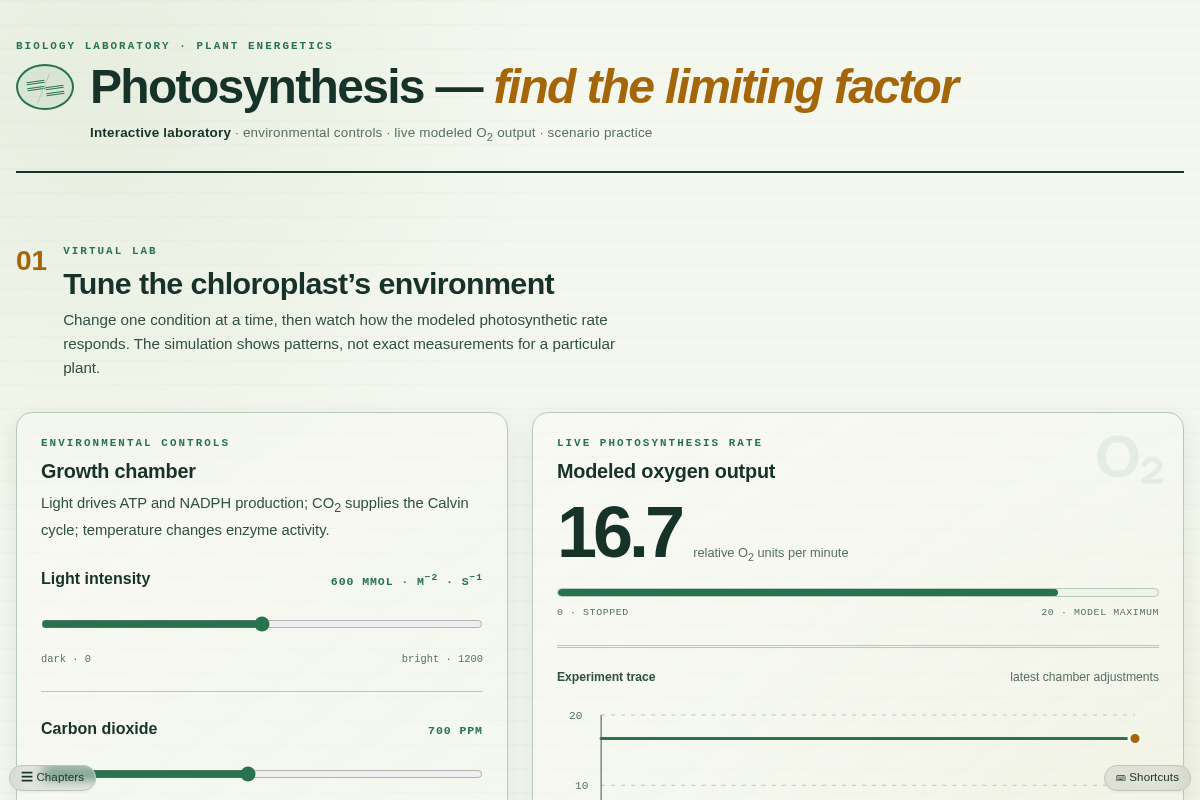
    Interactive Photosynthesis Laboratoryby Keroshan PillayMSE104 Material Science 104 at UCLA features an interactive photosynthesis laboratory where students control light intensity, CO2 levels, and temperature to observe real-time rate changes, plus a five-question scenario quiz with detailed explanations and mobile-responsive design.Dr. Amartya Banerjee · Winter 2022Made about 2 months ago
  • Open MSE 104 — Fracture and Failure Mode Classifier
    Preview of MSE 104 — Fracture and Failure Mode Classifier
    Practice Q&A
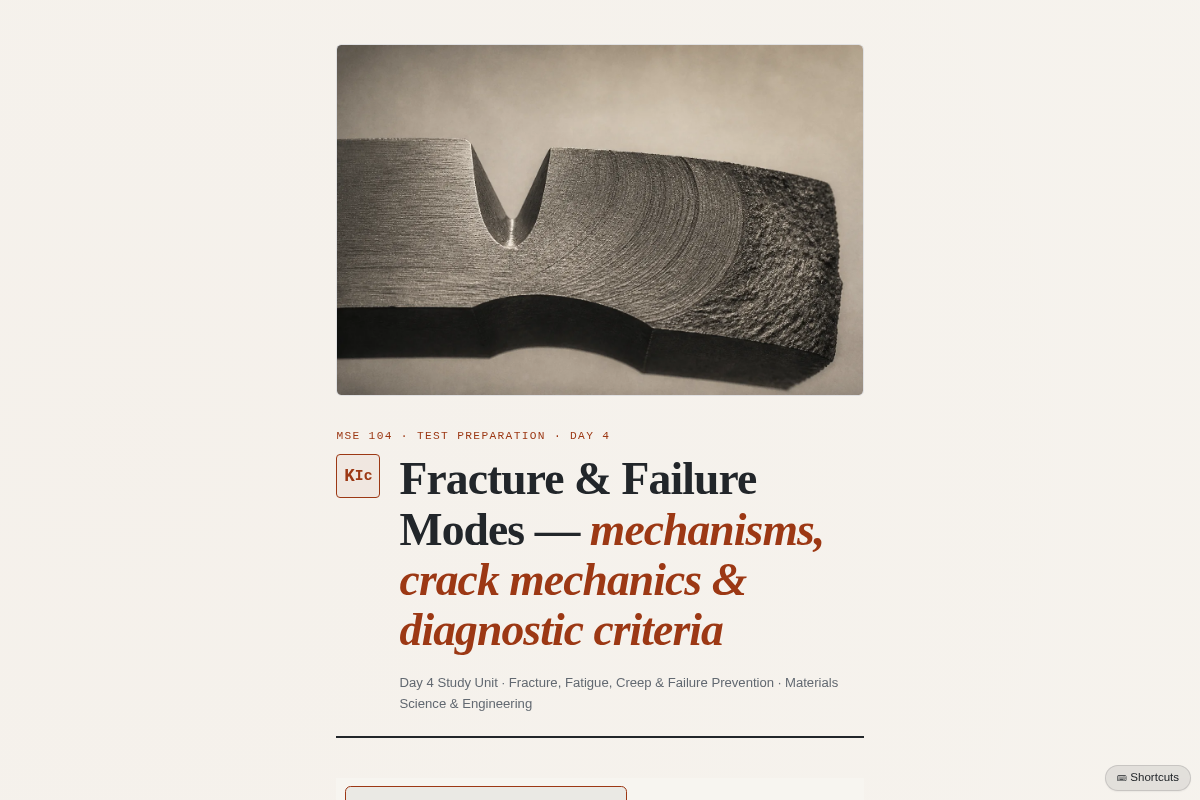
    MSE 104 — Fracture and Failure Mode Classifierby Keroshan PillayMSE104 Fracture and Failure Mode Classifier at UCLA presents scenario-based classification exercises that help students recognize different failure modes and eliminate answer choices in multiple-choice questions about material science fracture mechanisms.Dr. Amartya Banerjee · Winter 2022Made 2 months ago
  • Page 1 of 2Next